Wednesday, September 29, 2010

The Manic Pixie Dream Girl


In my research for my Honors Thesis, I came across a fascinating cultural criticism: a stock female character named the Manic Pixie Dream Girl. Probably my favorite part of my thesis, it's driven my thoughts on about women in film ever since. As such, you'll probably see more talk of her throughout my reviews, so I figured I'd write more about her here.


The Manic Pixie Dream Girl (MPDG) is a term coined by Nathan Rabin: The Manic Pixie Dream Girl exists solely in the fevered imaginations of sensitive writer-directors to teach broodingly soulful young men to embrace life and its infinite mysteries and adventures." The characterization has been investigated among many cultural venues across internet forums and through film site articles, trying to pinpoint the purpose of the appearance of this archetype in multiple films. The A.V. Club notes that "the Manic Pixie Dream Girl archetype is largely defined by secondary status and lack of an inner life. She's on hand to lift a gloomy male protagonist out of the doldrums, not to pursue her own happiness" (Bowman).

I was mostly intrigued by the idea because there have been MPDGs throughout all historical cycles of the romantic comedy, which has traditionally been considered a women's genre. So if women are watching, and continuing to watch, representations of a stale, flat characterization of a MPDG, what does that say about their thoughts of themselves, of society, of relationships, of who they're supposed to be, and how they're supposed to act?

Tuesday, September 28, 2010

A Word About Something New

At the end of some of my posts you might see this (-) or this (+). This is my new signifier for if the film fails (-) or passes (+) the Bechdel Test. (The video that I linked to illustrates the point really well, but just in case I have lazy readers, I will delineate and summarize...)

The Bechdel Test comes from a comic created by Allison Bechdel in 1985. It's three simple rules that assess the presence of women in films. The rules are:
1) Are there at least two women in the film (who have names),
2) Do they talk to each other,
3) About something other than a man?

There are SO MANY films that don't pass the test, illustrating that the Hollywood industry is built upon movies that cater to and are about men.

Though this test by no means denotes whether the film is "good" or "bad," I want to evaluate films according to these three rules because I think it's important to be aware of the systemic problem, and hopefully think of ways of overcoming it.

New Low


My interest in and study of romantic comedies led me to this film, an appraised quirky indie-flick. Though it wasn't quite to par with "professional" film, the independent filmmakers created the world well--I felt like I was there and knew the area. And kudos for the amateur-writer who still generated lots of out-loud laughing from the audience.

I was fascinated to find out that it was, in fact, a breakup romcom, featuring a MPDG, and a lackluster male protagonist. Though, surprisingly, the film *didn't* follow the pattern I had observed within my other three research movies, which was delightfully refreshing.

I wasn't struck with much feeling right after the showing, but now as I reflect on the film, it's clear that I really was attached to the characters, and still experience discomfort/joy/frustration/disappointment right along with Wendell's character.

three and a half.

(-)

Obselidia


The opening line from the trailer reads, "I even feel nostalgia with things in the present...." My personal compilications of feeling the exact same thing compelled me to see this Sundance film.

George, a lonely librarian, spends his spare time compiling an encyclopedia of obsolete things. He is frustrated with humanity's obsession with the "new" when the "old" works just fine. On his journey to document lost knowledge, he finds his ideas challenged by a Sophie, a silent film projection worker, and romance develops.

Though the film was quirky and interesting and profound in many ways that I like, I think it worked much better as a premise. The award-winning cinematography was absolutely beautiful, and could fool someone into believing that it was a great film, but the story beneath was more politically-than-story-oriented. The relationship between Sophie and George seemed contrived, and though it was nontraditional, it didn't make Sophie's MPDG status any more bearable.

Beautiful to watch. Interesting premise. Disappointing payoff.

two and a half.

or maybe a three, because it was beautiful.

(-)

Saturday, September 25, 2010

Whip It


Drew Barrymore's directorial debut film, this indie-flick about roller-derby had so many things that I love--roller skating, indie-grunge characters, ambiguous time-period (well, it was obviously modern times, but the values and priorities seemed set in the past. I like that), and unconventional narrative twists. The film sets itself up to be a traditional underdog sports romance film, but in the end turns out to be much more focused on self-discovery and navigating important (& sometimes suffocating) relationships with people (mostly parents).

I know that my personal attachment to nontraditional romantic comedies, my studies of genre techniques, and my ongoing negotiation of relational dialectics with my mother--made this film particularly interesting for *me*, but I also think there's a universal value in experimenting with the rules that typically define filmmaking, which were particularly enticing in this flick.

four

(+)

Saturday, July 24, 2010

Toy Story 3


The end of an epic adventure from my childhood, I couldn't help but feel immediately attached and excited and connected to the latest Pixar film. My theories about the generational marketing tactics aside, I genuinely enjoyed this epic adventure. The characters were just as wacky as ever, and the nonstop action kept my rapt attention, and I don't know *how* they did it, but they made the ending sequence one of the most emotional scenes I've witnessed--and it was an animated film about toys. Great storytelling. Great filmmaking.

five.

Wednesday, July 7, 2010

The Runaways


I loved parts of it, I hated others, and I felt disappointment when the alcohol, drug, sex swirl felt like any other vagabond band movie. But I thought Dakota Fanning and Kristen Stewart delivered surprising performances, and the grunge of the underground music scene was mostly entrancing, and only at times overdramatized.

three and a half.

Thursday, June 17, 2010

Greenberg


I had high expectations for the movie, but when I left the theatre I felt...nothing, really. I was so ambivalent about this film that I couldn't even muster disappointment. Ben Stiller played the moody, neurotic, narcissistic has-been to such levels of frustration that I had to check out of the story in order to stay present in the theatre. By the end of the film, I didn't feel like he had changed at all, and was upset that his only motivation to do so was the Manic-Pixie-Dream-Girl Florence. A few poignant lines captured (what I perceive to be) the essence of the middle-age psyche, but since it was made for an older audience, I didn't feel like I could appreciate it in the same types of ways.

two and half.

Monday, June 14, 2010

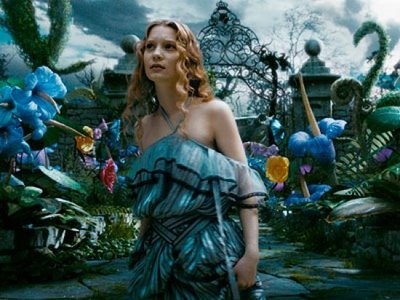
Alice in Wonderland


I was excited about this movie, since it taps into (and I think has since created?) a world of weirdness and eccentricity of style. I've never read the books, unfortunately, but I found the movie to be engaging and fast-paced, and I thought the not-so-subtle emphasis on destiny vs choice was intriguing, and just so ambivalently navigated to feel satisfied with the questioning, and free to form independent interpretations.

three

Hot Tub Time Machine


Four men take a trip to the vacation spot of their glory days, and due to a glitch with the wiring of their hot tub, travel back in time to 1986. The film is horrendously flawed in its plotline, but it's obvious as the film progresses that it claims nothing in the way of story structure. Yet through a cleverly written script, the characters manage to employ every expected convention, and then proceed to make fun of it in all kinds of hilarious self-reflexivity. It's lewd, offensive, and surprisingly funny.

three.

Saturday, June 5, 2010

Thelma and Louise


I don't know why it took me so long to watch this classic film, because I knew immediately that I was going to love it. Perhaps recent personal issues made the movie even more resonant, but regardless, I enjoyed every funny, awful, heroic moment. Though it's focused on a particular zeitgeist, I think its story transcends and speaks to contemporary women's issues in just as many poignant ways. The film wrestles with heavy gender issues in a way that left me feeling just enough hope in the midst of overwhelming disappointment, because, hey? What else can you do?

five

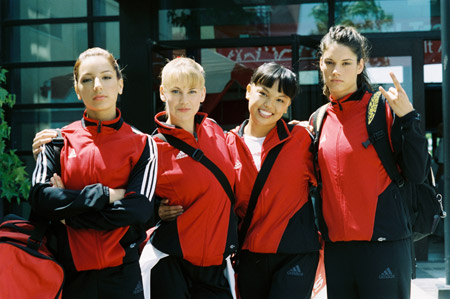
Stick It


This coming-of-age, underdog, sports flick offered a surprising twist that rendered this ABCfamily television special into a rule-bending, convention tweaking, uplifting film. The film questions institutions and celebrates talent, and while the meant-to-be-emotionally-laden back stories are cliched, the rest of the film isn't. Taking into account the intended distribution venues, I was still able to appreciate its music-video-esque editing techniques and enjoy the character redemptions that inadvertently (though perhaps not so subtly) questioned The Man.

three...and a half.